Overview
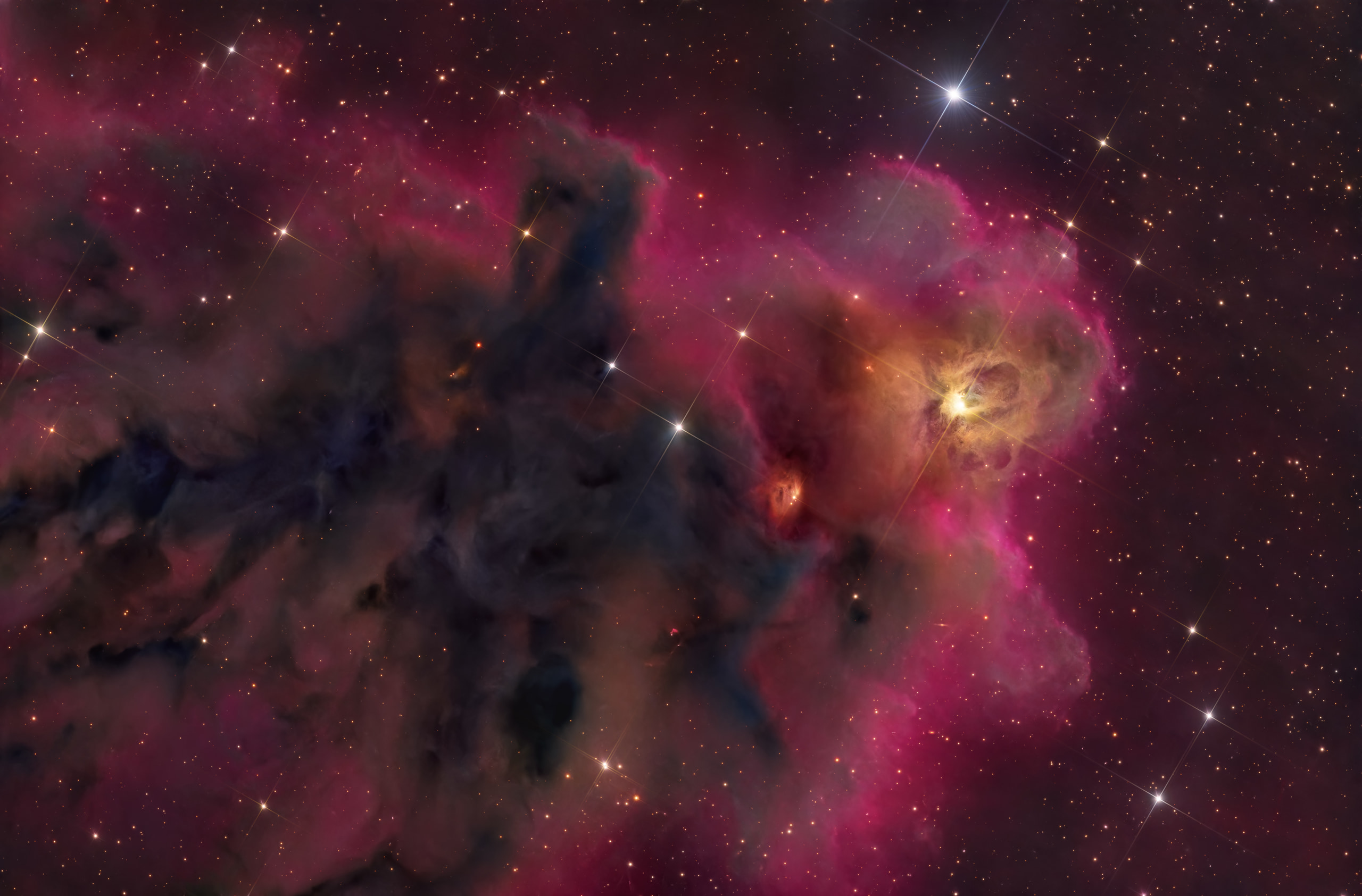
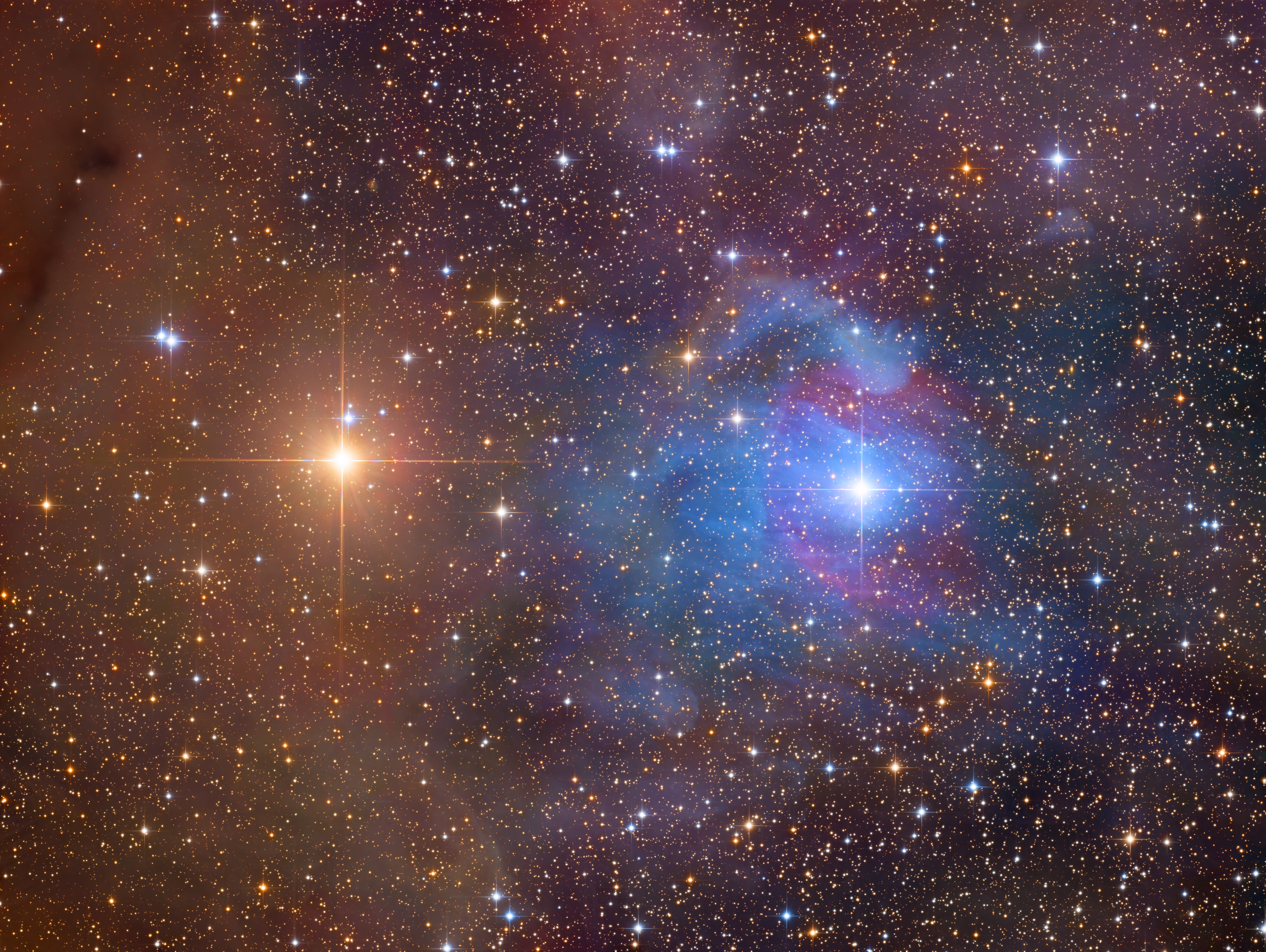
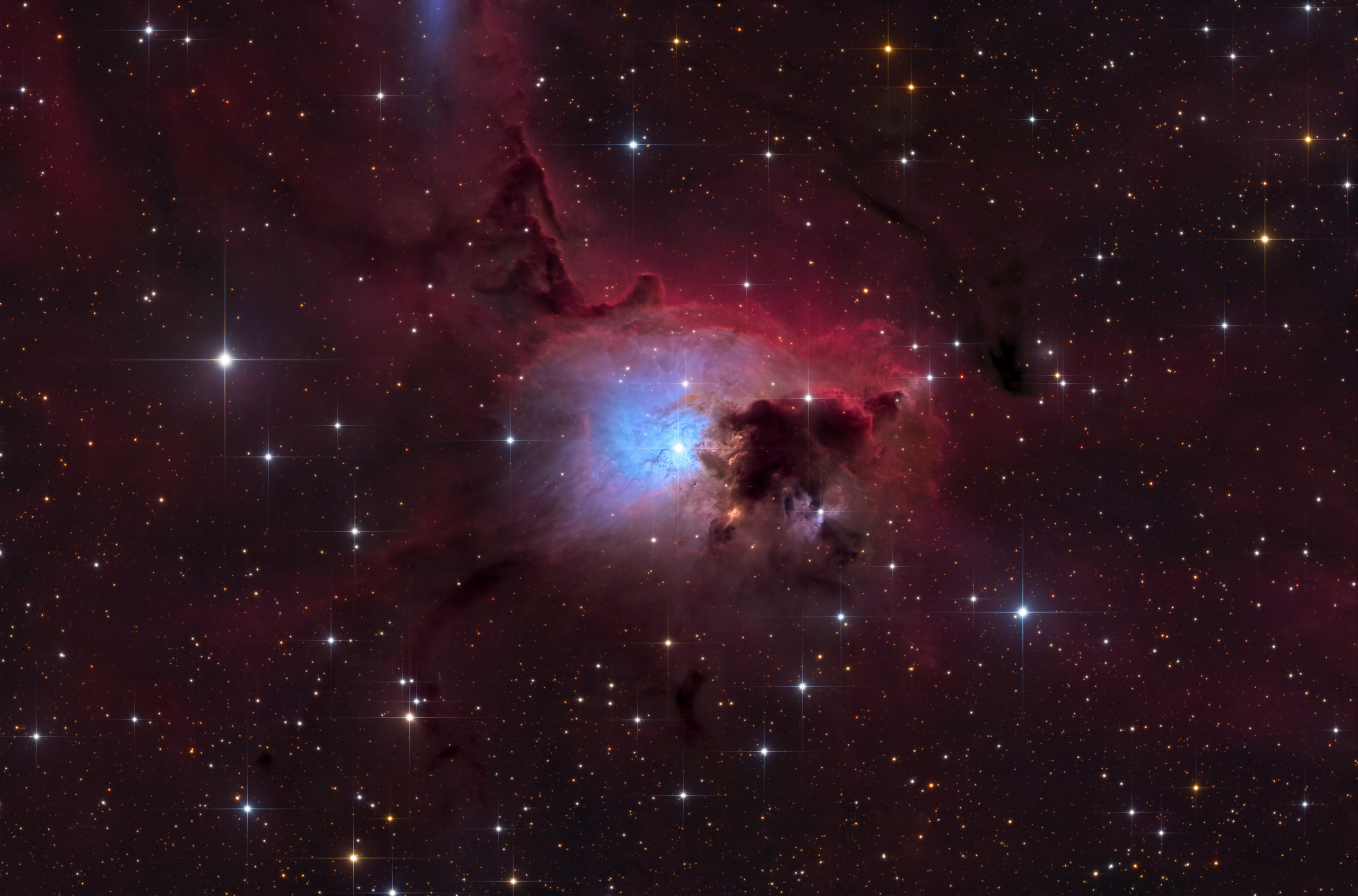
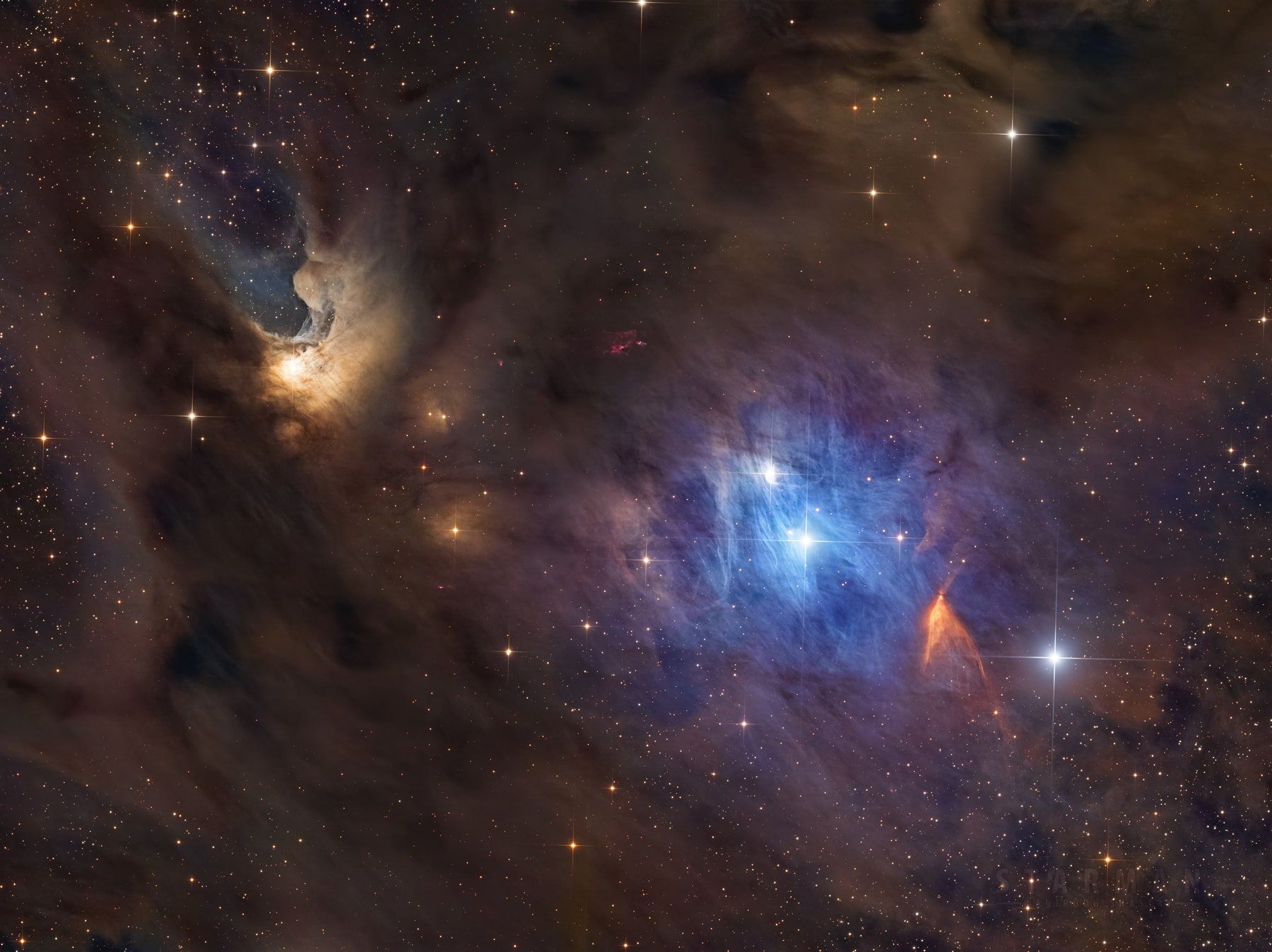
Bernes 142 is a dark cloud at the heart of Chamaeleon I, one of the nearest stellar nurseries to the Sun at roughly 600 light years. Bernes’ 1977 catalogue was a survey of bright nebulae buried inside opaque dust, and this field holds three of them, each a lantern lit by a star that has only just begun to shine. The cloud sits so far south that it never rises for most of the world. From Chile it circles the celestial pole and never sets.
Right of center, and a little below it, glows Cederblad 111, an electric blue reflection nebula wrapped around HD 97048, a young Herbig Ae/Be star still carrying its birth disk. The dust streams past it in fine combed filaments, like smoke caught in a beam of light. To the upper left, Cederblad 110 answers in warm amber, a reflection nebula split by a dark lane and hollowed into a C shape. Hidden inside it is the protostar Ced 110 IRS 4, a binary so deeply embedded that only infrared telescopes can see it. The James Webb Space Telescope recently read the ices frozen onto the cloud’s grains in its light.
Below and to the right of the blue, a small orange fan opens up: the Chamaeleon Infrared Nebula, a bipolar reflection nebula carved by jets from a newborn low mass star tunneling its way out of the cloud. The faint crimson knots scattered between the nebulae are shocked gas where other outflows slam into the cloud, the only places in the frame where the dust is forced to glow on its own.
What holds me in this image is how much of it is dark. The nebulae are small islands, and everything around them is molecular cloud, folding over itself in brown and ochre layers thick enough to swallow the background stars. Seventeen hours of exposure went into that darkness, chasing the faint texture of the cloud until the shadows themselves became the subject.
Captured from my remote setup at Obstech in Chile:
🔭 PlaneWave CDK500 Observatory System
📸 Moravian C5A-100M Camera
🎨 Chroma L, R, G, B Filters
📀 L: 68×300s, R: 80×180s, G: 78×180s, B: 74×180s (17.27 hours)
🖥️ Processed in PixInsight and Adobe Photoshop