






Overview
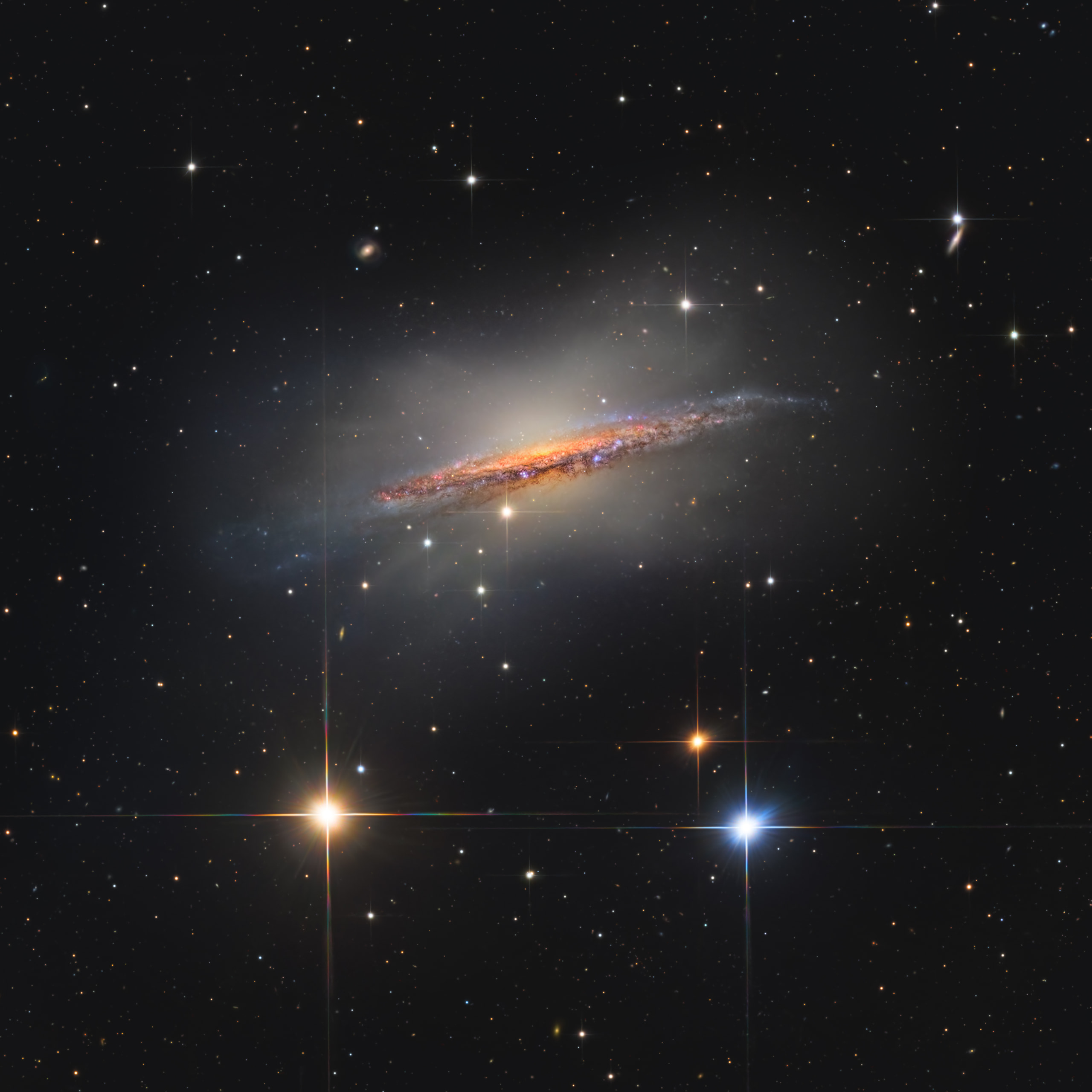
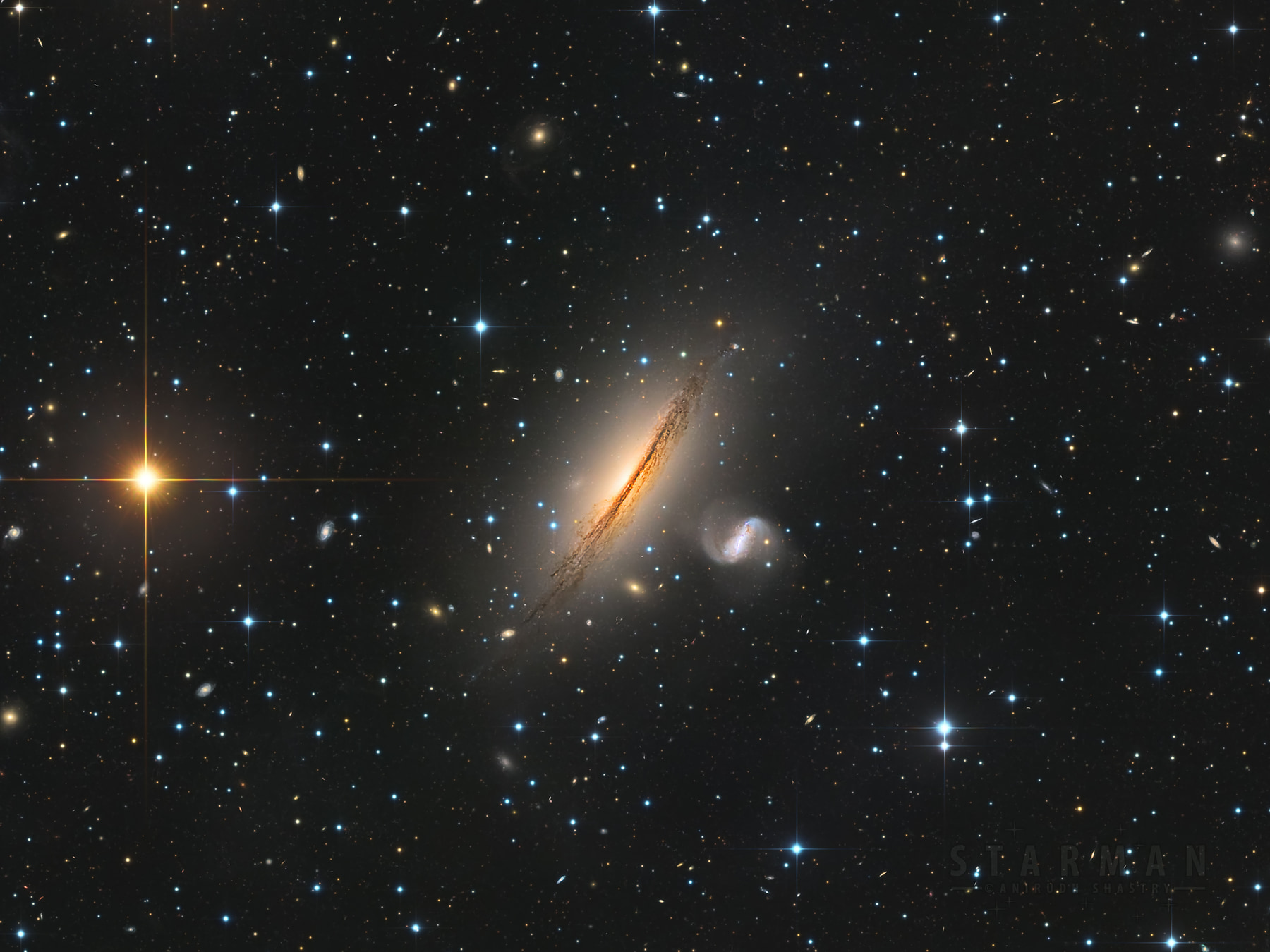
NGC 5078 is an edge-on spiral galaxy adrift in the quiet reaches of Hydra, roughly 90 million light-years away. Its golden core burns at the center of a soft, pale halo of ancient stars, and slicing across that light is the galaxy’s defining feature: a ragged, knotted dust lane that runs the full length of the disk. Where many edge-on spirals wear their dust as a thin, disciplined line, the lane in NGC 5078 is torn and turbulent, fraying into dark tendrils that spill above and below the plane. That distortion is not decoration. It is evidence of an encounter still in progress.
The culprit hangs just beside it: IC 879, a small spiral caught in NGC 5078’s gravitational grip. In the image it appears as a delicate blue-white swirl twisted into a soft S, its cool tones a quiet counterpoint to the warm gold of its larger neighbor. The two galaxies are close enough to be exchanging more than glances. Tidal forces from the passage have roughened the larger galaxy’s dust lane and wound the little companion out of shape. It is a portrait of galactic interaction at its most intimate scale, not the head-on collision of the Antennae but a slow, deliberate distortion, two islands of stars reshaping one another across a narrow strait of darkness.
What I love about this field is everything happening around the pair. A blazing golden foreground star anchors the left side of the frame, its diffraction spikes stretching across the darkness, a member of our own galaxy photobombing a scene 90 million light-years deeper. And scattered through every corner of the image, the background resolves into galaxies beyond counting, tiny spirals, ellipticals, and edge-on slivers drifting behind the main subject, turning the black sky itself into a measure of depth.
Over 25 hours of integration went into this rendering. Long luminance exposures pull the faint stellar halo and the outer reaches of the disk out of the sky, and the RGB preserves the delicate color balance between the aging golden core and the cooler tones at the disk’s edge.
Captured from my remote setup at Obstech in Chile:
🔭 PlaneWave CDK600 Observatory System
📸 Moravian C5A-100M Camera
🎨 Chroma L, R, G, and B Filters
📀 L: 55×600s, R: 70×300s, G: 60×300s, B: 61×300s (25.08 hours)
🖥️ Processed in PixInsight and Adobe Photoshop