




Overview
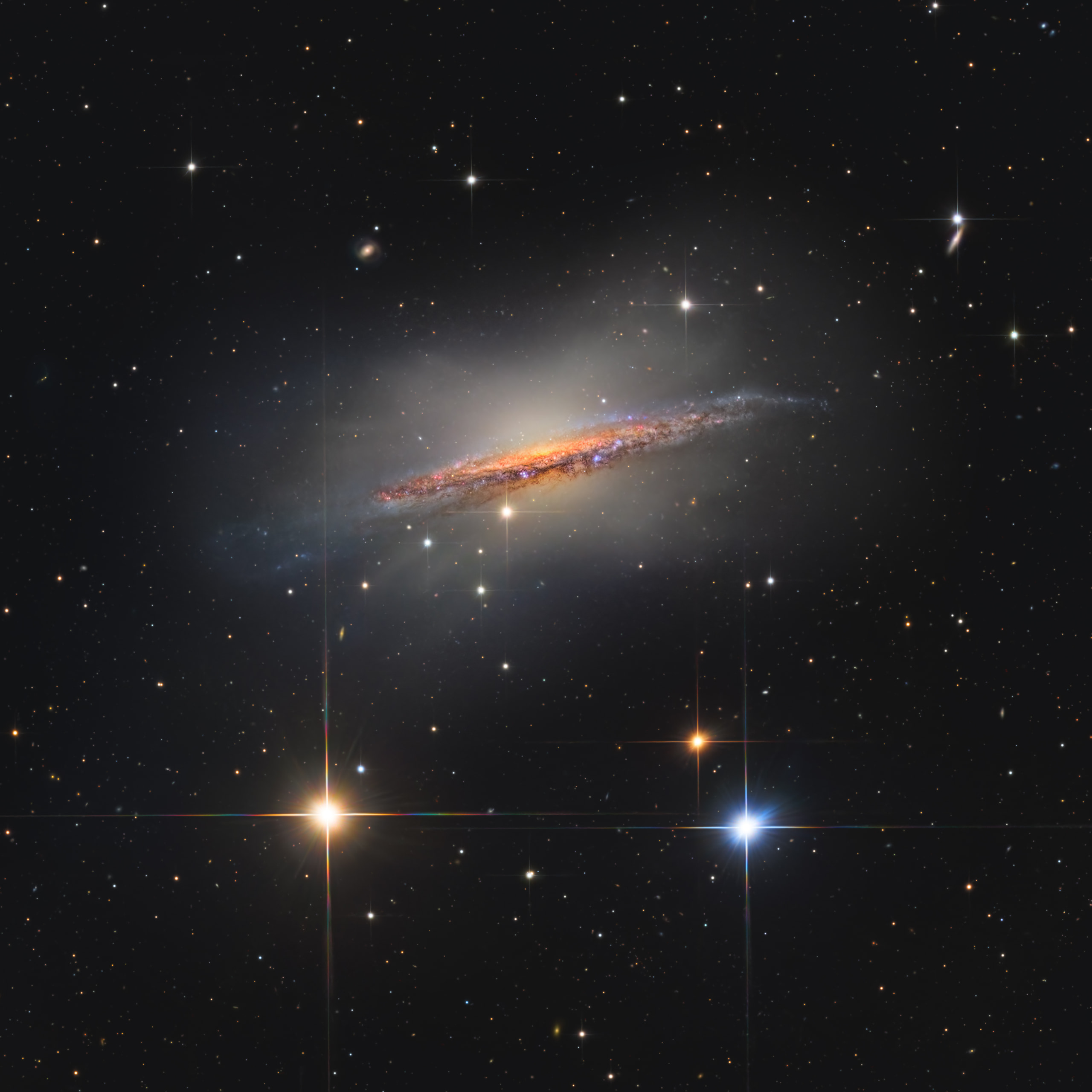
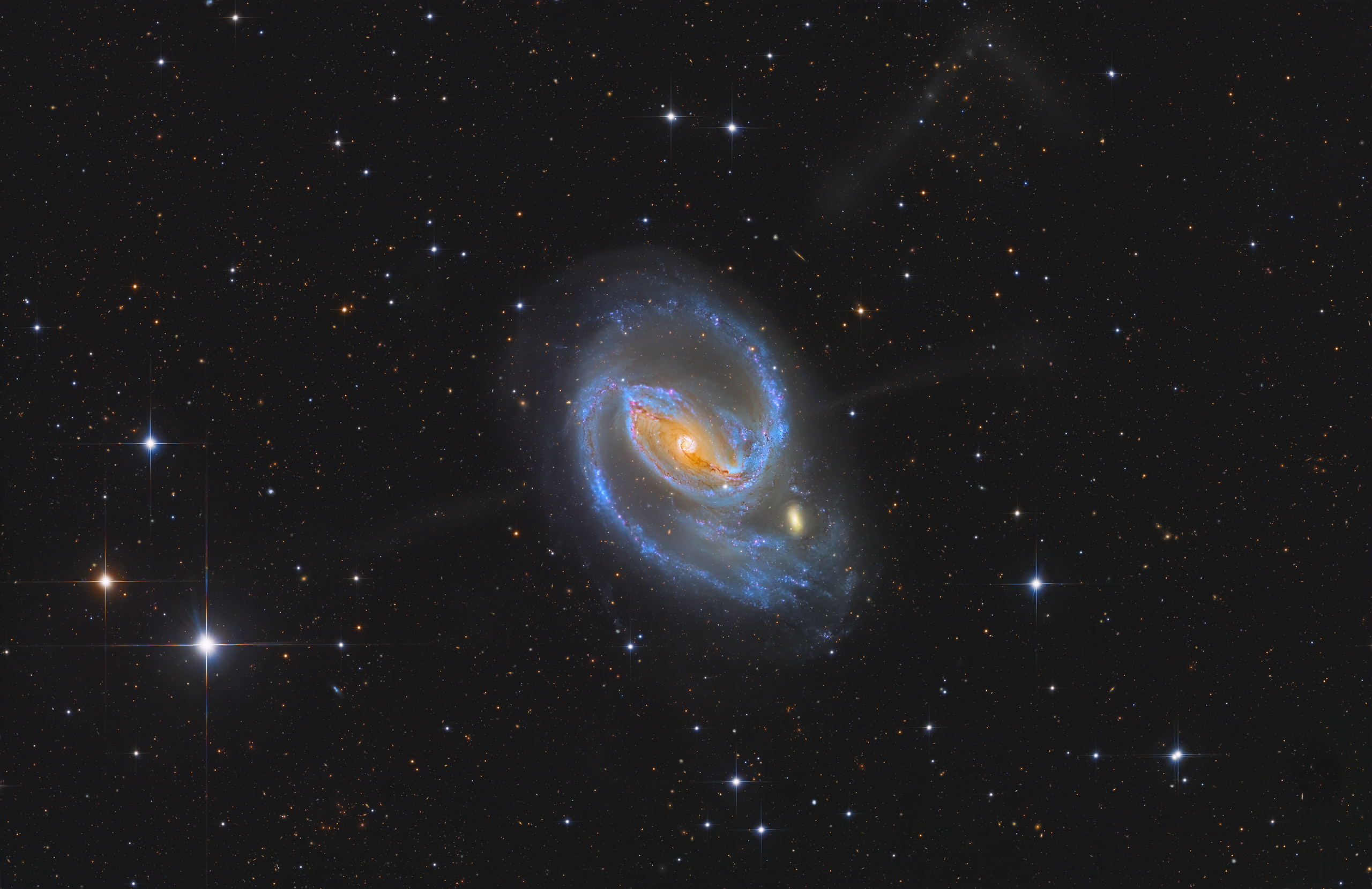
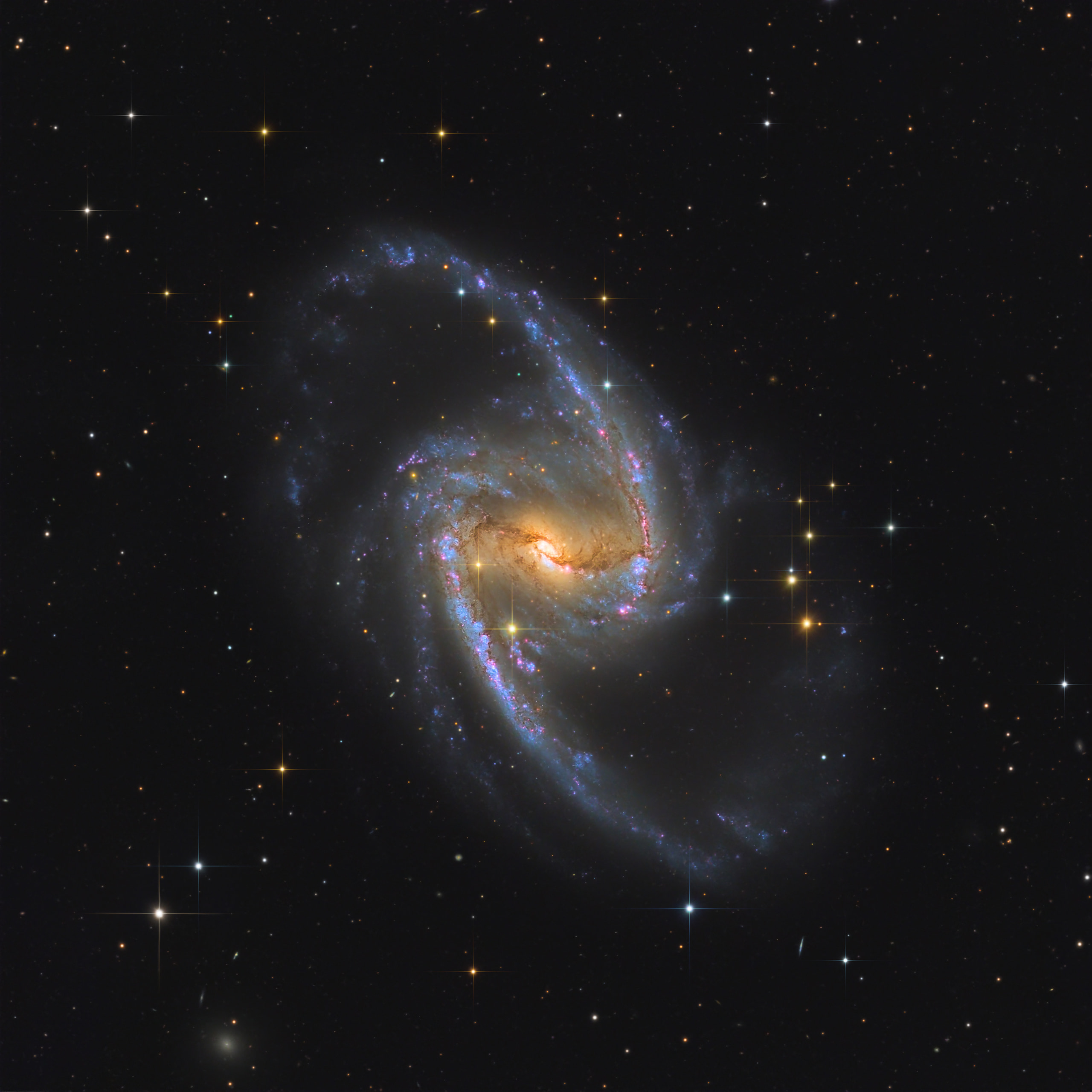
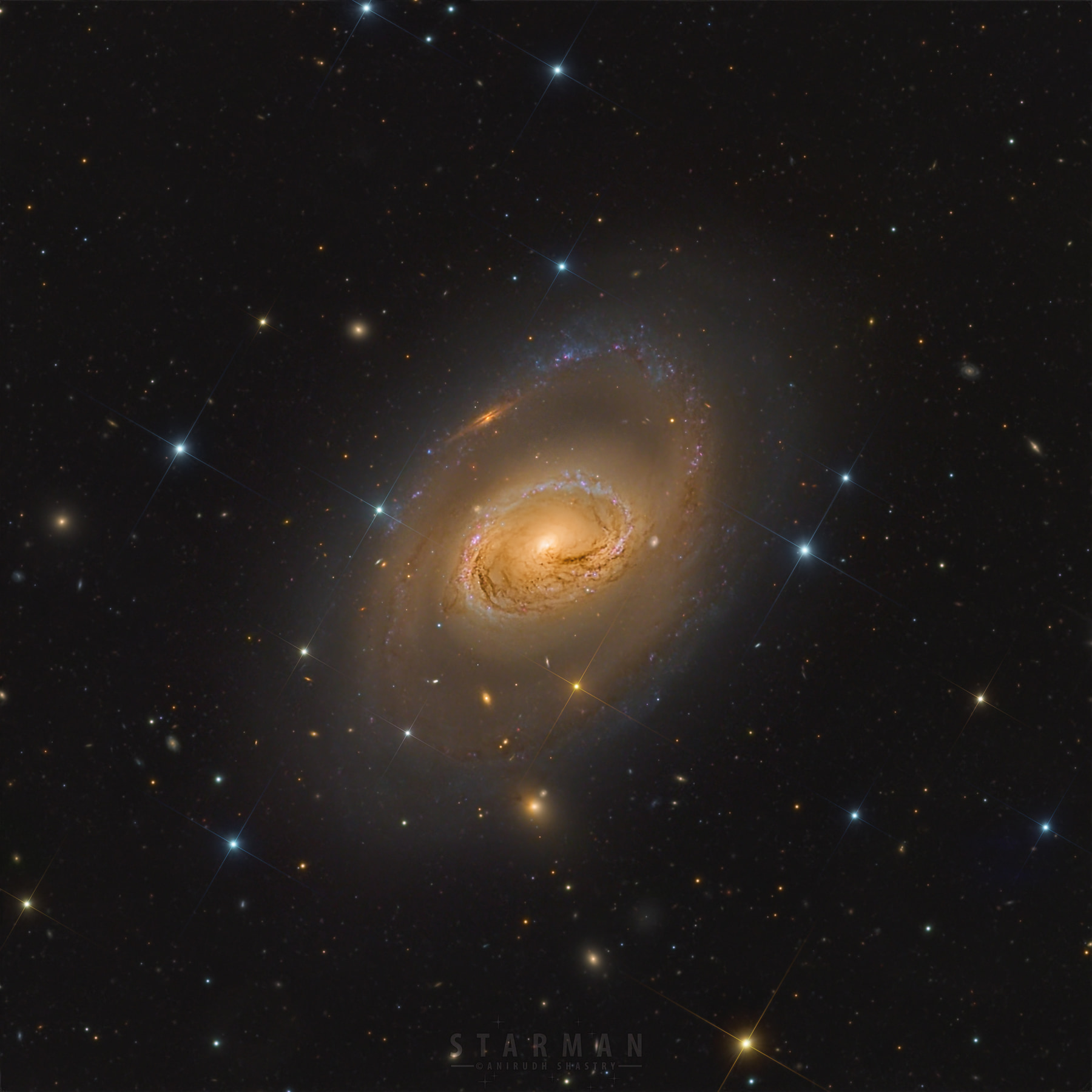
M 96 is the brightest member of the Leo I group, a luminous spiral turning some 31 million light-years away in the constellation of the Lion. Its heart is a furnace of old golden light, wrapped in a tight coil of dark dust that swirls around the nucleus like smoke caught in an eddy. Around that burning center spreads a smooth, pale envelope of ancient stars, and around the envelope runs the galaxy’s great outer arm, strung with beads of blue star clusters and rose-pink HII regions like a necklace of newborn suns. But the symmetry is an illusion. The dust crowds one side of the core and thins on the other, the arm blazes with star formation along its northern arc and fades to a quiet ribbon on the south, and the whole disk sits subtly askew, like a heart beating out of place.
And then there is the baby. Tucked just inside the sweep of that jeweled upper arm, a small coppery edge-on spiral glows against the pale envelope, its own dust lane clearly visible, its light reddened by distance. It lies hundreds of millions of light-years beyond M 96 and is utterly unrelated to it, yet from our line of sight the arm curls around the little galaxy like a protective arm around an infant, and the nickname becomes unavoidable. It is pure perspective, a chance alignment across a gulf of space deeper than the entire Leo group, but the eye refuses to see it any other way. Once you have seen M 96 holding the baby, you cannot unsee it.
The lopsidedness is not an accident of processing. M 96 shares its corner of Leo with M 95, M 105, and a crowd of smaller companions, and eons of gravitational conversation among them have pulled the galaxy subtly out of true. The displaced dust, the asymmetric arms, and the offset core are the fingerprints of neighbors tugging at one another across millions of light-years, a reminder that even the most serene-looking spiral lives inside a web of forces we can read only in its distortions.
Just over 20 hours of integration went into this rendering. The long luminance exposures were essential for the smooth outer envelope, which fades so gently into the sky that it takes real depth to hold both it and the tiny galaxy it appears to cradle. The RGB was balanced to preserve the contrast that gives M 96 its character: the aging golden light of the core against the cool blue clusters and pink star-forming knots threaded along the arm. Around it, the field carries its own quiet drama, blue foreground stars of our own galaxy throwing diffraction spikes across the frame, a golden elliptical pair glowing to the south, and dozens of faint background galaxies drifting behind it all like distant lanterns.
Captured from my remote setup at Obstech in Chile:
🔭 PlaneWave CDK500 Observatory System
📸 Moravian C3-61000 PRO Camera
🎨 Chroma L, R, G, and B Filters
📀 L: 50×600s, R: 51×300s, G: 49×300s, B: 47×300s (20.58 hours)
🖥️ Processed in PixInsight and Adobe Photoshop